
https://youtu.be/h0SJi4KcYNw?si=Yfmkkk43JAEQzGS0
April 28, 2026
By C. Locke
Fifty-two percent of New Hampshire voters say housing is the top issue facing residents, and 80 percent of those same voters believe there are too few homes for “average people to rent or buy,” according to a survey released by Housing Action New Hampshire. Results from other recent polls also indicate that the issue has been frustrating citizens since at least the Covid years due to record-high selling costs, low inventory, restrictive zoning, workforce and older population needs, the costs of supplies and labor, and the need for state involvement.
Experts met April 22 at Hampshire Hills in Milford for a special panel on the “New Hampshire Housing Crisis” to explore with its audience the nature of the current local and state challenges and to highlight recent practical solutions across the state. The event was organized by the Amherst Democrats and the Milford Democrats in response to widespread concern about housing costs.
Why housing isn’t affordable in NH
According to Sarah Wrightsman, manager of Community Engagement and Education for New Hampshire Housing, income has not kept up with housing costs for essential workers. In 1998, a single-family home purchase price was three times the median household income. Today that number is about five times the income: a household needs to earn about $174,000 to buy a median-priced home.
Renters, often those with lowest incomes, are even more cost-burdened, spending about 80 percent of their annual income on housing.
Most of the workforce, the “essential” workers – nurses and home health aides, police, carpenters, electricians, and the like – have seen 50-70 percent of their income vacuumed up by housing, compared to 20-40 percent in 2010, said Wrightsman. “Many workers in high-demand occupations . . . earn wages well below what is needed to afford median rents,” according to New Hampshire Housing.
The costs of homes are also rising for existing homes if the surrounding new and existing homes are increasing in value.
Low inventory
Another headwind in the market is low supply, which drives prices up. New Hampshire faces an average of just one-month’s supply in the market for all home types, down from nearly 14 months in 2009.
Jay Minkara, executive director of the Nashua Regional Planning Commission (NRPC), which performs regional housing needs assessments, said the Nashua region, which shows a large deficit, will need 5,000 houses and rental units in the next four years, and, by 2030, an additional 9,000 units.
Across the Nashua region, some communities do not currently need to add housing, but many should, said Minkara. Merrimack has developed the most units, contributing to 32 percent of all regional development. Hollis has exceeded its current target and Brookline has also added significant housing. Although Amherst issues about 25 building permits a year, 74 are needed to meet NRPC recommendations.
Five or more units – the dominant kind of development – comprise nearly 50 percent of all units. Single-family used to be the largest kind of development but are being built at the level of demand – 34 percent. Communities are adding few “middle housing” units, those for two, three or four families, according to Minkara.
Single greatest variable in determining development: local regulations
Traditionally, New Hampshire housing has been devoted to the single-family home and preservation of the town character. Decades of zoning ordinances such as building density, lot size, housing types, frontage, and parking have supported the model. However, today’s housing demands are pressuring communities to consider a different New England town profile that includes the high-density “missing middle” homes such as duplexes, townhouses, and cottage courts – all which require changes to ordinances.
Mikara said a trend in towns has been zoning methods by petition. Usually, one particular development can set off a petition with fear (such as of excessive traffic) often driving the change. Communities need to address those concerns with their residents, he said. “One town spent three years thinking and discussing publicly what they wanted. Much of the work comes down to design – finding projects that townspeople would like. And then put in the regulations to help carry it out. Town government is what we struggle with.”
Changing workforce and aging owners
Business is the last to see effects on the economy, according to Natch Greyes, the vice president of Public Policy for the Business and Industry Association of New Hampshire. His organization follows the current and future workforce, the “life cycle” that involves housing. The state chalks up the second-oldest population in the nation and the oldest workforce in the nation. This means fewer workers than in 2019; in ten years, New Hampshire will need to replace more than one-quarter of its workforce.
Housing is the greatest issue attracting new workers and needs to be near the workplace, said Greyes. Dartmouth-Hitchcock has two full-time staff to find housing for potential hires and to find permanent housing for employees who rent, for example.
Additionally, homeowners, especially older owners, said Greyes, are also concerned with having enough capital to do the next “shift” in their lives. Many seniors often want to downsize into a smaller house and use capital of the home for next level of living.
When the panel was asked about middle-style housing, which helps retiring seniors, the answer was that this is also a supply issue. The aging population is seeking smaller homes, but they often own larger homes and are not incented to downsize. Greyes said we need to think about this age group and the “missing” middle housing: we actually lower costs in the community if we can help them purchase in certain communities – because of their nature to support others, he said.
Blending multi-generational housing with programs such as Medicaid’s Funding Choices for Independents (at home care) could assist seniors in staying in their homes rather than turning to senior assisted living, said Al Howland, representative of the NH House Housing Committee.
Costs of building
Greyes highlighted another key issue: 1,400-square-foot homes, the starter and down-size homes, are not being built because builders cannot realize enough profits on small lots or homes combined with condos and these demand water and sewer infrastructure minimally. Builders seek an 8-12 percent profit but since 2020 are hampered by rising labor and building materials costs and nearly-doubling land costs.
Getting to solutions
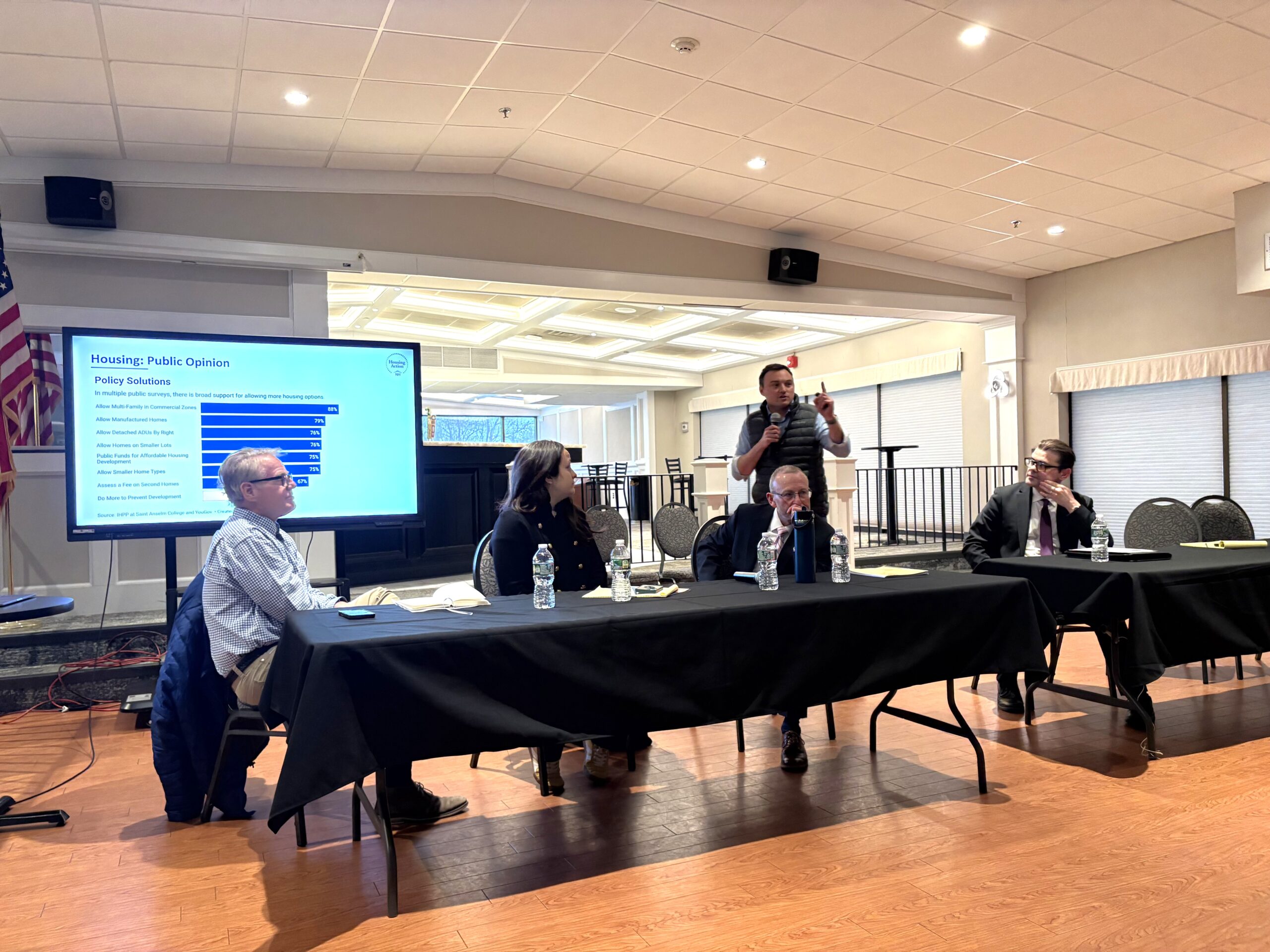
Nick Taylor, director of Housing Action NH, which lobbies on state and federal policy, said 87 percent of voters believe every level of government from local to state to federal “should take action to address the cost and availability of homes.” Taylor provided more details on what housing policy solutions the public would like:
- 88% Allow multifamily in comm zones (with infrastructure)
- 79% Support manufactured homes (many towns ban these) – a possible affordable alternative
- 76% allow detached ADUs by right
- 76% allow homes on smaller lots
- 75% should be public funds available for affordable housing
- 35% Do more to prevent development
The housing problems can be addressed with a best-practice process for development, such as the Housing Champions program, said Howland. A proven method would entail identifying the land use reforms and the available infrastructure via the town capital improvement plan, largely sewers and water; training of the townspeople; and developing financial incentives, without state input.
Paying great attention to the design of a project is a requisite for getting results.
“Spend the effort on broader outreach – into the committees and commissions,” he suggested. “Put a lot of effort into helping people visualize these, especially the densities,” said Howland, “because people are afraid of [the densities].”
Howland suggested communities consider adding residential structures to commercial areas, a mixed use, perhaps with supporting business and facilities such as daycare, learning pods, and a school. Other strategies may be “funded inclusionary zoning” – searching out underutilized land and using tools to fund the project. He cited the successful example of Portland, Oregon that experimented by building “middle missing housing,” homes smaller than the single-family homes where these new-sized homes did not lower the value of the latter.
Housing experts are recognizing that planning capabilities in communities are very limited. Wrightsman said, “There are a lot of communities that have no professional planning staff locally” and recommends New Hampshire invest in regional planning commissions to help with that job. As an example, when dozens of communities received funding to hire consultants, nearly all used it to complete projects such as assessing housing or examining and amending land use regulations.
Local funds
Encumbered by high building and land costs and zoning regulations, communities are seeking alternate strategies. One audience participant asked how to engage non-profit developers who build affordable housing.
Howland responded, “If you have town-owned land that you can use (and you’re not making money on it), that is a good incentive,” but he cautioned that the lower a town builds on the income scale, the less it will be able to build.
Some communities have created their own trust funds for affordable housing, said Minkara. Some have taken advantage of American Rescue Plan Act (ARPA) funding (contracting ended in 2024) and others work with nonprofit affordable housing builders by using low-income housing tax credits.
Leadership’s role
“The state wants to push the responsibilities down, but towns need help from state. This is a state crisis,” said one participant. She added she does not see a sense of urgency. “Maybe it shouldn’t be up to average citizens to determine what are the implications of zoning regulations,” she said, adding that planning boards may not have the expertise.
Additionally, the state budget for housing continues to decrease. In FY24-25 budget, $57 million was allotted to housing programs; for ’26-27, only $17.5 million. That’s more than 65-70 percent less than the previous budget.
Invest NH (a housing development grant program administered by NH BEA) was budgeted from $10 million to zero dollars. Funding for the regional planning commissions was reduced from their $500 thousand to 0$. The state senate voted on April 23 to keep the Housing Champions program, so local programs under way will receive their committed funding, but there is no funding in the 2026-2027 budget.
Programs do currently provide some support, said Taylor, such as the CDFA tax credit program – “tax credits for rehabbing older buildings,” and “state rental assistance through HHS.”
Last year the legislature recognized some of the problems have to be boosted by state policies, such as a bill that helped preserve the downtown character of Portsmouth, said Greyes. The legislature also passed several bills to allow multifamily units and commercial zones to allow detached ADUs by Right. The legislature wants to help with the right levers, said Greyes.
Taylor added that some legislation works and conversations are happening because there is such a sense of urgency. “But there is a question of what role does the state and federal government play for setting guard rails and having some incentives,” he posited.
A Bedford townsperson who worked on a small community project said he received “some guidelines from the state that communities are supposed to try to address, but it felt like there was no teeth to take it to the next level, to track it to the next level. And that seemed to be lost in the process.”
The state could look at what’s working effectively in certain communities, said Howland, and could help by creating some model ordinances to start some educational process – to help communities learn how to plan better (or at all). Some towns, for example, may not be thinking about models such as cluster developments.
The building can also become a competition between towns. Howland said that in his district, Dover built a good deal because they had the attractive infrastructure. Merrimack is shouldering the region’s building increase because of its regulations, location, and infrastructure. “We need regional planning help to coordinate what’s been built in a region and what could be built. What works well in certain communities could be shared with other towns,” Howland added.
Help with affordable homes for lower income levels?
A Milford resident asked, “Are we looking at income levels in each town? [We’re] not hearing about how to keep people in our towns with affordable housing. Having discussions about helping people pay for their rent? Or incenting small business owners, and carpenters and the like to ‘build up’ on existing houses?”
Minkarah responded that there is no way our communities can develop housing for people in lower incomes without some kinds or blends of subsidies because of costs and local regulations.
“And pretty much across the board, those levels of funding support have been decreasing,” he said. Howland added that communities will have to accept different housing models for affordability, such as the modular or manufactured house.
Some building programs have achieved some successes in the state. The New Hampshire Affordable Housing Fund provides financing for developers, largely for building or rehabilitating housing units in the $20-30 thousand yearly income. The state is also receiving $350 million in Federal Housing and Urban Development (HUD) programs, added Taylor.
Because a good deal of funding goes through New Hampshire programs, said Taylor, “we have got to be continuing to track and watch all of those programs as the federal budget process flows through NH housing.”
Concerned citizens should pay attention to the coming NH budget year (2026-2027), said Taylor, “because that’s where you have real opportunity to hit that level of the market.”
On citizen involvement, Taylor also said, “The loudest voice in the room is not the majority, right? And so when you’re thinking about how we make some of these policy decisions, it’s not necessarily only the person who is standing up. . . but it’s really thinking about the folks who can’t come to a meeting at night because they’re working a second job or they have kids at home that they’re putting into bed and they don’t have time to come testify to everything.”
Additional sources: